
Play Is Development: What Your Child Is Really Learning

4 minutes

Ollie from Oxford Explorers

Parenting
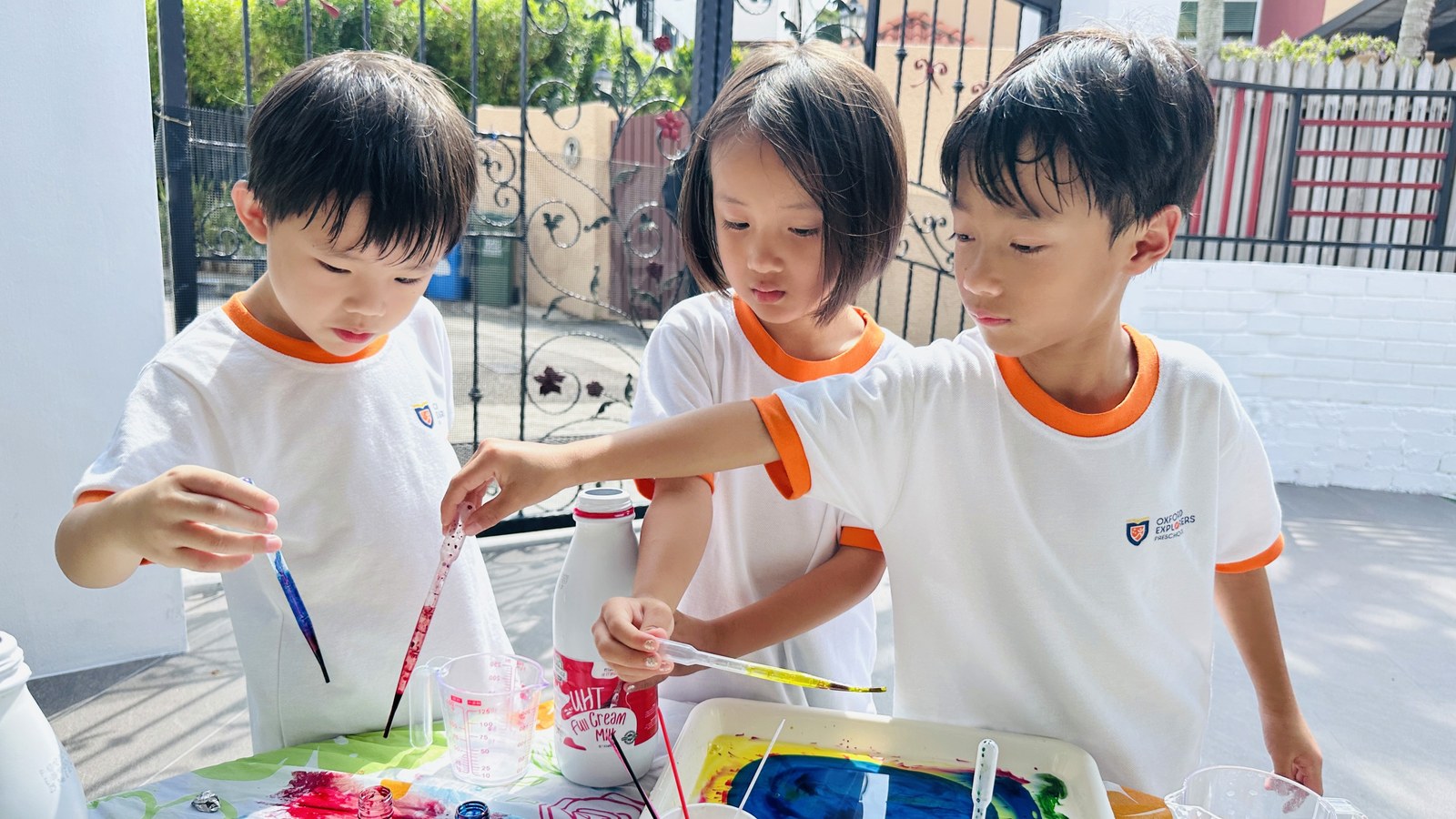
Why purposeful play builds language, executive function, confidence and the capacity to learn with others

Three children turn a row of cushions into a boat. One draws a map. Another announces a storm. The third insists that everyone needs a ticket and begins collecting rectangular blocks as payment.

It looks delightfully unserious. Yet the children are planning, using symbols, negotiating roles, developing language, managing disagreement and adapting when the story changes. Play is not the opposite of learning. For young children, it is one of the main ways development happens.

Otters know a thing or two about play. Fortunately, Singapore's early-years framework agrees.

Singapore calls it purposeful play

Singapore's Nurturing Early Learners framework places purposeful play within quality preschool practice. The idea is not to disguise every worksheet as a game. It is to create experiences with clear learning intentions while giving children meaningful choice, active involvement and room to construct knowledge.[1]

This balance matters. Constant adult direction can make children passive. Completely unsupported play can be rich, but may not always extend a particular capability. In purposeful play, the educator designs and facilitates; the child investigates and influences what happens next.

Five kinds of development hiding in plain sight
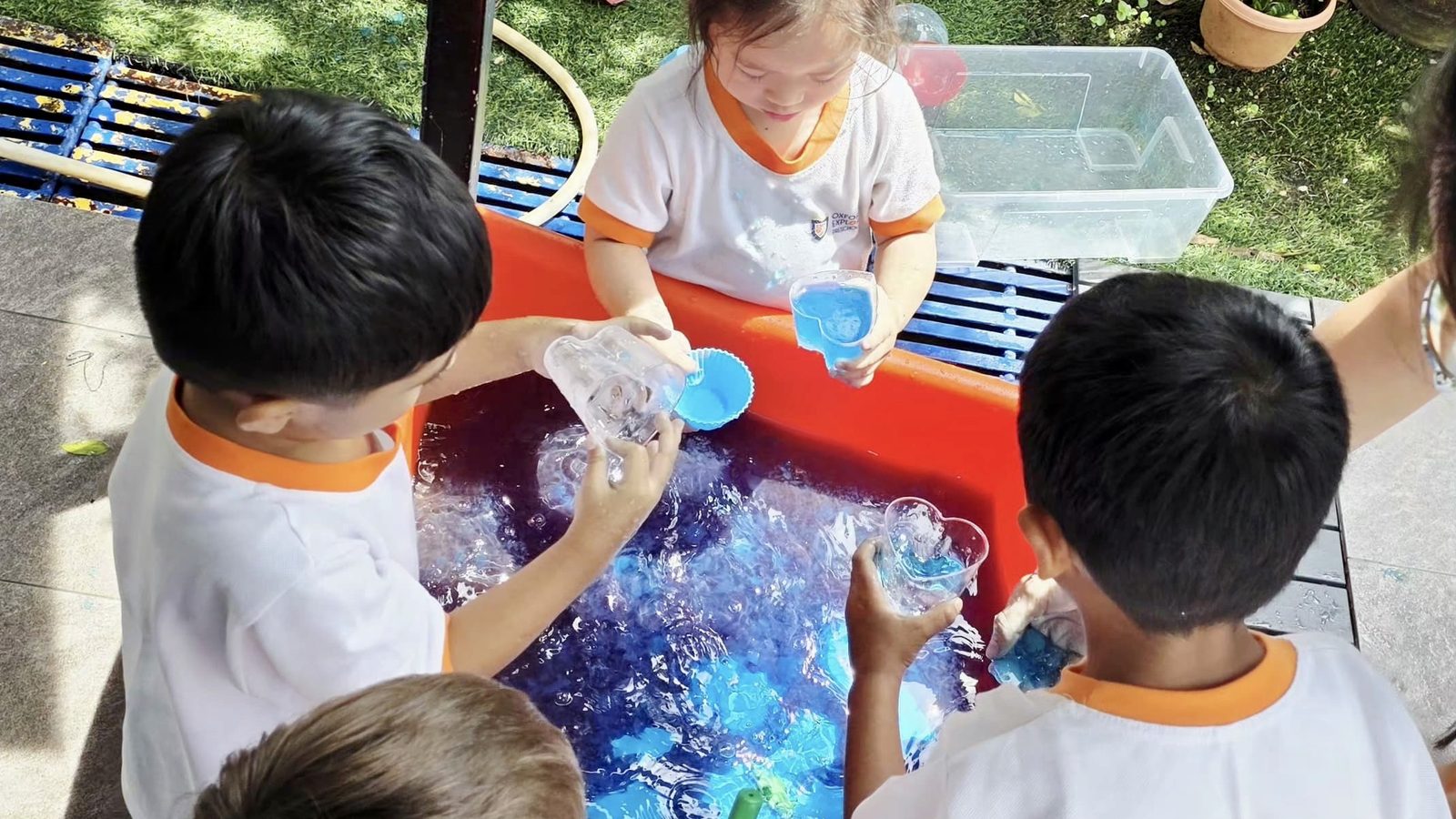
Preschool children at Oxford Explorers Singapore experimenting at an outdoor water tray.

Language and literacy: pretend scenarios give children a genuine reason to speak, listen, explain and use new vocabulary. Writing matters because a shop needs labels, a journey needs a map and a performance needs tickets.

Mathematical thinking: blocks introduce shape, quantity, balance and spatial reasoning. Shop play brings counting and comparison. Construction invites measurement, pattern and problem-solving.

Scientific thinking: children predict, test and revise. Will the bridge hold? Which object floats? What changes when water meets sand?

Social and emotional development: children practise entering a group, reading intention, taking turns, coping with disappointment and repairing disagreements.

Physical development: active play builds strength and coordination, while drawing, construction and manipulating small objects refine hand control.

A play area is not enough

Singapore research makes an important distinction between providing play materials and creating high-quality play. A study of 108 K1 classrooms found that learning centres were widely present, but children's choice and the quality of instructional support were often limited.[2]

The lesson is not that play fails. It is that play requires professional judgement. Skilled educators protect enough time for an idea to develop, introduce materials with several possibilities and decide whether to ask a question, model a strategy, add vocabulary or remain quiet.

'Tell me about your bridge' opens thinking. Rebuilding it for the child closes it. Sometimes the most sophisticated teaching move is to interrupt less.

Free, guided and structured play do different jobs

Free play is child-led and develops agency, imagination and sustained engagement. Guided play keeps the child in charge while the educator shapes the environment or asks a well-timed question. Structured play has clearer rules or adult direction, as in movement games, puzzles, songs and team challenges.

A high-quality programme uses all three. A recent randomised study in China found that ten weeks of movement, puzzle and language play supported aspects of executive function in four- to five-year-olds, including inhibitory control and cognitive flexibility.[3] The study was modest in size, but it reinforces a useful point: different kinds of play exercise different mental muscles.

What purposeful play looks like at Oxford Explorers

At Oxford Explorers, play is connected to clear curriculum progression. A construction challenge can develop counting, measurement and vocabulary. A role-play area can become a neighbourhood shop, clinic or delivery service, combining communication, social understanding and early writing. A story can move into drama, music, art and an investigation of the wider world.

Educators observe how each child approaches the experience and adjust the next step. One child may need support joining a group. Another may be ready for a harder number problem. Another may ask an unexpected question that becomes tomorrow's investigation. The child has agency; the educator has intention.

Protecting play at home

Leave some time unscheduled. Offer open-ended materials such as blocks, boxes, cloth, containers, drawing tools and natural objects. Describe before directing: 'You made the base wider this time.' Ask fewer, better questions: 'What do you notice?', 'What is your plan?' or 'What could you try next?'

Ollie's takeaway

Play prepares children for school because it builds language, attention, self-regulation, coordination, confidence and the ability to learn with others. More importantly, it teaches that ideas can be tested, mistakes can be repaired and difficult things may become possible with another attempt. That is not time away from development. That is development. Let's Explore Together! 🦦

Sources and further reading

[1] Singapore Ministry of Education, Nurturing Early Learners Framework.

[2] Bautista et al., Purposeful play during learning centre time: from curriculum to practice.

[3] Zhao et al., The effect of child-appropriate play with various types on preschoolers executive function.

Book an Explorer Day to see this in action at our Braddell or Bayshore centre.

More Related Articles

A Curriculum That Protects Childhood - and Prepares Children for What Comes Next

How Oxford Explorers blends the UK EYFS and Singapore's NEL framework into one coherent learning journey

Watch a child sort pebbles by size, explain the pattern to a friend and then decide the smallest one is a 'dragon egg'. Is that mathematics, language, imagination or social learning? The honest answer is: all of them.

Young children do not develop in tidy subject boxes. A strong curriculum respects that, while still giving educators a clear view of what each child is learning and what should come next.

For parents in Singapore, the choice is sometimes presented as a joyful, play-rich childhood or serious preparation for Primary 1. At Oxford Explorers, we think that is a false choice. Protect the joy, then use it to build readiness with purpose. That is the clever bit.

The blend: different frameworks, different jobs

EYFS provides the developmental lens. The UK Early Years Foundation Stage considers seven connected areas of learning and places particular emphasis on communication, physical development, and personal, social and emotional development. It guides how educators observe, model, extend and plan through play and guided learning.[1]

NEL provides the Singapore learning map. Singapore's Nurturing Early Learners framework sets local goals across language and literacy, numeracy, discovery of the world, aesthetics and creative expression, and health, safety and motor skills development. It also foregrounds values, social-emotional competencies and learning dispositions.[2]

EYDF supports the earliest years. For children from birth to three, Singapore's Early Years Development Framework keeps cognitive, language, physical and social-emotional development connected and responsive.[3]

Oxford Explorers provides the progression. We translate the frameworks into six connected domains: Communication & Language, Chinese Immersion, Mathematics & Logical Thinking, Understanding the World, Expressive Arts & Design, and Physical Development. The balance becomes progressively more structured from Playgroup to K2 - without turning preschool into an early version of primary school.

What the blend looks like in one real experience

Preschool children from Oxford Explorers walking with their educators on a neighbourhood walk in Singapore.

The practical blend begins with a meaningful experience, not a stack of disconnected objectives. Take a neighbourhood investigation. Children might walk nearby, notice signs and buildings, count features, discuss who works there, create a collaborative mural and later present a dream home or neighbourhood.

The EYFS lens helps the educator notice language, confidence, collaboration, movement and imagination. The NEL map makes local goals visible across literacy, numeracy, discovery, creative expression and social awareness. Oxford Explorers then adds age-by-age progression: younger children name, sort and represent what they saw; older children tally, map, write labels, explain design choices and present to a group.

The child experiences one coherent adventure. The educator sees the many capabilities developing inside it. Ideas also become easier to remember because words, numbers, movement and emotion are connected to a real experience. No need to choose between a joyful project and purposeful learning - they are doing the same work.

How the balance changes from Playgroup to K2

In Playgroup and Pre-Nursery, secure relationships, routines, sensory exploration, songs, movement and responsive conversation do most of the heavy lifting. Through Nursery, projects last longer, vocabulary expands and early literacy and numeracy become more visible. In K1 and K2, phonics, comprehension, number relationships, problem-solving, presentation and independence become increasingly explicit.

Oxford Explorers also introduces selected concepts from the local Primary 1 syllabus. These are not delivered as compressed primary-school lessons. Children meet them through concrete materials, stories, experiments, discussion and reasoning. Sorting and counting develop towards tallying, place value, data handling and simple word problems. Stories and poems develop into retelling, oral comprehension, show-and-tell and early writing.

The educator makes the blend real

A framework cannot create quality by itself. A Singapore study of 108 K1 classrooms found that simply providing learning centres did not guarantee purposeful play; the quality of adult instructional support mattered.[4]

That is why Oxford Explorers educators observe closely and intervene deliberately. One child may need a new word. Another may need help entering a group. A third may be ready for a harder number relationship. The experience can be shared while the next step remains individual.

An otter, if you will forgive the comparison, does not learn the river by studying a map of it. Neither does a child learn the world from a worksheet. Both need someone nearby who knows which part is worth exploring next.

Ollie's takeaway

A strong curriculum should be visible in the child, not only in the timetable. By K2, look for confident communication, curiosity with numbers and stories, growing independence, resilience and the ability to learn with others. Global developmental practice, Singapore relevance and clear progression should feel like one journey. Let's Explore Together! 🦦

Sources and further reading

[1] UK Department for Education, Early years foundation stage statutory framework.

[2] Singapore Ministry of Education, Nurturing Early Learners Framework.

[3] Early Childhood Development Agency, Early Years Development Framework 2023.

[4] Bautista et al., Purposeful play during learning centre time: from curriculum to practice.

Book an Explorer Day to see this in action at our Braddell or Bayshore centre.

4 minutes

Why Outdoor Play Belongs at the Heart of Preschool

How time outside develops movement, attention, confidence, social judgement - and healthier visual habits

To an adult, a puddle may be something to avoid. To a young child, it is a physics experiment, a sensory experience and an excellent opportunity to discover whether two feet make a bigger splash than one.

Outdoor play gives children room to move, materials that change and problems without one correct answer. It is sometimes treated as a break from learning. For young children, it is one of the richest places where learning happens.

Young bodies need space to move

Singapore's physical activity guidance recommends that children aged three to six accumulate at least 180 minutes of varied activity across the day, including at least 60 minutes at moderate-to-vigorous intensity.[1] Preschool is only one part of that day, but regular outdoor sessions make movement easier, more varied and much more joyful.

Running, climbing, balancing, digging, carrying and throwing build strength, coordination and spatial awareness. Handling leaves, sand, water and tools develops fine motor control too. These foundations support everyday independence and later classroom tasks, from opening a lunchbox to controlling a pencil.

The brain is moving too

Preschool children exploring plants in the garden at Oxford Explorers Singapore.

Singapore's Early Childhood Development Agency describes outdoor learning as learning in, about and through the outdoors.[2] A nature hunt develops observation, classification and vocabulary. Gardening introduces responsibility and change over time. Water play invites prediction and experimentation. An obstacle course develops planning as well as balance: where should I place my foot, what comes next, and what can I change if it does not work?

Outdoor materials are wonderfully uncooperative. A leaf blows away. Sand changes when it is wet. A stick refuses to look exactly like the picture. That unpredictability asks children to notice, adapt and invent. As an otter, I may be slightly biased - but messy, open-ended materials are excellent teachers.

Confidence grows through manageable challenge

Young children need sensible opportunities to test what their bodies can do. Stepping across uneven ground, climbing to an appropriate height or moving quickly around others requires judgement. With close supervision and clear boundaries, children learn to assess distance, capability and consequence.

The aim is not to remove risk entirely. It is to distinguish a worthwhile challenge from a genuine hazard. When adults make every decision, children remain safe in the moment but gain less practice making decisions for themselves.

Outdoor play is social learning

Outside, children negotiate space, wait for equipment, invent rules and adapt when a game changes. These moments exercise communication, self-control and perspective-taking. Disagreements are not proof that play has failed; with skilled adult support, they are opportunities to practise repairing relationships.

The outdoors also creates authentic reasons to communicate. Children need language to coordinate a den, agree a race route, explain a discovery or ask a friend to help carry something heavy. These conversations are spontaneous, purposeful and often sustained. For children who find a busy classroom demanding, the extra space and sensory variety can also make participation feel more accessible.

A small but important eye-health benefit

Outdoor time may also help delay the onset of myopia. Singapore HealthHub recommends at least two hours outdoors each day.[3] A randomised school trial in Guangzhou found that adding 40 outdoor minutes each day reduced new cases over three years,[4] and a Singapore cohort study of older children and teenagers found more outdoor activity was associated with lower odds of myopia.[5] Most of this evidence comes from primary-school age and above rather than preschoolers, so treat outdoor time as preventive support rather than a cure, alongside eye checks and healthy near-work habits.

What outdoor learning looks like at Oxford Explorers

At Oxford Explorers, outdoor time is part of the daily rhythm rather than an occasional reward. Children encounter obstacle courses, nature hunts, gardening, water and sensory play, team games and neighbourhood walks. Each experience has a physical purpose and a learning purpose, while still leaving room for the child to discover something the adult did not plan.

Ollie's takeaway

When you visit a preschool, ask four questions: How often are children outside? What do they actually do there? How do educators extend the learning? How are shade, hydration and weather managed? A little dirt on a uniform is easy to wash out. Confidence, coordination, curiosity and sound judgement are much more valuable things to bring home. Let's Explore Together! 🦦

Sources and further reading

[1] HealthHub Singapore, Getting Fit Through Fun for Kids.

[2] Early Childhood Development Agency, Outdoor Learning.

[3] HealthHub Singapore, Healthy Eyes, Clear Vision.

[4] He et al., Effect of Time Spent Outdoors at School on the Development of Myopia Among Children in China.

[5] Dirani et al., Outdoor activity and myopia in Singapore teenage children.

Book an Explorer Day to see this in action at our Braddell or Bayshore centre.

4 minutes

At Oxford Explorers, academic readiness and a joyful childhood belong together.

Copyright © 2026 Oxford Explorers Preschool All Rights Reserved | Terms and Conditions | Privacy Policy

At Oxford Explorers, academic readiness and a joyful childhood belong together.

Copyright © 2026 Oxford Explorers Preschool | All Rights Reserved
Terms and Conditions | Privacy Policy

Play Is Development: What Your Child Is Really Learning

4 minutes

Ollie from Oxford Explorers

Parenting

Why purposeful play builds language, executive function, confidence and the capacity to learn with others

Three children turn a row of cushions into a boat. One draws a map. Another announces a storm. The third insists that everyone needs a ticket and begins collecting rectangular blocks as payment.

It looks delightfully unserious. Yet the children are planning, using symbols, negotiating roles, developing language, managing disagreement and adapting when the story changes. Play is not the opposite of learning. For young children, it is one of the main ways development happens.

Otters know a thing or two about play. Fortunately, Singapore's early-years framework agrees.

Singapore calls it purposeful play

Singapore's Nurturing Early Learners framework places purposeful play within quality preschool practice. The idea is not to disguise every worksheet as a game. It is to create experiences with clear learning intentions while giving children meaningful choice, active involvement and room to construct knowledge.[1]

This balance matters. Constant adult direction can make children passive. Completely unsupported play can be rich, but may not always extend a particular capability. In purposeful play, the educator designs and facilitates; the child investigates and influences what happens next.

Five kinds of development hiding in plain sight

Preschool children at Oxford Explorers Singapore experimenting at an outdoor water tray.

Language and literacy: pretend scenarios give children a genuine reason to speak, listen, explain and use new vocabulary. Writing matters because a shop needs labels, a journey needs a map and a performance needs tickets.

Mathematical thinking: blocks introduce shape, quantity, balance and spatial reasoning. Shop play brings counting and comparison. Construction invites measurement, pattern and problem-solving.

Scientific thinking: children predict, test and revise. Will the bridge hold? Which object floats? What changes when water meets sand?

Social and emotional development: children practise entering a group, reading intention, taking turns, coping with disappointment and repairing disagreements.

Physical development: active play builds strength and coordination, while drawing, construction and manipulating small objects refine hand control.

A play area is not enough

Singapore research makes an important distinction between providing play materials and creating high-quality play. A study of 108 K1 classrooms found that learning centres were widely present, but children's choice and the quality of instructional support were often limited.[2]

The lesson is not that play fails. It is that play requires professional judgement. Skilled educators protect enough time for an idea to develop, introduce materials with several possibilities and decide whether to ask a question, model a strategy, add vocabulary or remain quiet.

'Tell me about your bridge' opens thinking. Rebuilding it for the child closes it. Sometimes the most sophisticated teaching move is to interrupt less.

Free, guided and structured play do different jobs

Free play is child-led and develops agency, imagination and sustained engagement. Guided play keeps the child in charge while the educator shapes the environment or asks a well-timed question. Structured play has clearer rules or adult direction, as in movement games, puzzles, songs and team challenges.

A high-quality programme uses all three. A recent randomised study in China found that ten weeks of movement, puzzle and language play supported aspects of executive function in four- to five-year-olds, including inhibitory control and cognitive flexibility.[3] The study was modest in size, but it reinforces a useful point: different kinds of play exercise different mental muscles.

What purposeful play looks like at Oxford Explorers

At Oxford Explorers, play is connected to clear curriculum progression. A construction challenge can develop counting, measurement and vocabulary. A role-play area can become a neighbourhood shop, clinic or delivery service, combining communication, social understanding and early writing. A story can move into drama, music, art and an investigation of the wider world.

Educators observe how each child approaches the experience and adjust the next step. One child may need support joining a group. Another may be ready for a harder number problem. Another may ask an unexpected question that becomes tomorrow's investigation. The child has agency; the educator has intention.

Protecting play at home

Leave some time unscheduled. Offer open-ended materials such as blocks, boxes, cloth, containers, drawing tools and natural objects. Describe before directing: 'You made the base wider this time.' Ask fewer, better questions: 'What do you notice?', 'What is your plan?' or 'What could you try next?'

Ollie's takeaway

Play prepares children for school because it builds language, attention, self-regulation, coordination, confidence and the ability to learn with others. More importantly, it teaches that ideas can be tested, mistakes can be repaired and difficult things may become possible with another attempt. That is not time away from development. That is development. Let's Explore Together! 🦦

Sources and further reading

[1] Singapore Ministry of Education, Nurturing Early Learners Framework.

[2] Bautista et al., Purposeful play during learning centre time: from curriculum to practice.

[3] Zhao et al., The effect of child-appropriate play with various types on preschoolers executive function.

Book an Explorer Day to see this in action at our Braddell or Bayshore centre.

More Related Articles

A Curriculum That Protects Childhood - and Prepares Children for What Comes Next

How Oxford Explorers blends the UK EYFS and Singapore's NEL framework into one coherent learning journey

Watch a child sort pebbles by size, explain the pattern to a friend and then decide the smallest one is a 'dragon egg'. Is that mathematics, language, imagination or social learning? The honest answer is: all of them.

Young children do not develop in tidy subject boxes. A strong curriculum respects that, while still giving educators a clear view of what each child is learning and what should come next.

For parents in Singapore, the choice is sometimes presented as a joyful, play-rich childhood or serious preparation for Primary 1. At Oxford Explorers, we think that is a false choice. Protect the joy, then use it to build readiness with purpose. That is the clever bit.

The blend: different frameworks, different jobs

EYFS provides the developmental lens. The UK Early Years Foundation Stage considers seven connected areas of learning and places particular emphasis on communication, physical development, and personal, social and emotional development. It guides how educators observe, model, extend and plan through play and guided learning.[1]

NEL provides the Singapore learning map. Singapore's Nurturing Early Learners framework sets local goals across language and literacy, numeracy, discovery of the world, aesthetics and creative expression, and health, safety and motor skills development. It also foregrounds values, social-emotional competencies and learning dispositions.[2]

EYDF supports the earliest years. For children from birth to three, Singapore's Early Years Development Framework keeps cognitive, language, physical and social-emotional development connected and responsive.[3]

Oxford Explorers provides the progression. We translate the frameworks into six connected domains: Communication & Language, Chinese Immersion, Mathematics & Logical Thinking, Understanding the World, Expressive Arts & Design, and Physical Development. The balance becomes progressively more structured from Playgroup to K2 - without turning preschool into an early version of primary school.

What the blend looks like in one real experience

Preschool children from Oxford Explorers walking with their educators on a neighbourhood walk in Singapore.

The practical blend begins with a meaningful experience, not a stack of disconnected objectives. Take a neighbourhood investigation. Children might walk nearby, notice signs and buildings, count features, discuss who works there, create a collaborative mural and later present a dream home or neighbourhood.

The EYFS lens helps the educator notice language, confidence, collaboration, movement and imagination. The NEL map makes local goals visible across literacy, numeracy, discovery, creative expression and social awareness. Oxford Explorers then adds age-by-age progression: younger children name, sort and represent what they saw; older children tally, map, write labels, explain design choices and present to a group.

The child experiences one coherent adventure. The educator sees the many capabilities developing inside it. Ideas also become easier to remember because words, numbers, movement and emotion are connected to a real experience. No need to choose between a joyful project and purposeful learning - they are doing the same work.

How the balance changes from Playgroup to K2

In Playgroup and Pre-Nursery, secure relationships, routines, sensory exploration, songs, movement and responsive conversation do most of the heavy lifting. Through Nursery, projects last longer, vocabulary expands and early literacy and numeracy become more visible. In K1 and K2, phonics, comprehension, number relationships, problem-solving, presentation and independence become increasingly explicit.

Oxford Explorers also introduces selected concepts from the local Primary 1 syllabus. These are not delivered as compressed primary-school lessons. Children meet them through concrete materials, stories, experiments, discussion and reasoning. Sorting and counting develop towards tallying, place value, data handling and simple word problems. Stories and poems develop into retelling, oral comprehension, show-and-tell and early writing.

The educator makes the blend real

A framework cannot create quality by itself. A Singapore study of 108 K1 classrooms found that simply providing learning centres did not guarantee purposeful play; the quality of adult instructional support mattered.[4]

That is why Oxford Explorers educators observe closely and intervene deliberately. One child may need a new word. Another may need help entering a group. A third may be ready for a harder number relationship. The experience can be shared while the next step remains individual.

An otter, if you will forgive the comparison, does not learn the river by studying a map of it. Neither does a child learn the world from a worksheet. Both need someone nearby who knows which part is worth exploring next.

Ollie's takeaway

A strong curriculum should be visible in the child, not only in the timetable. By K2, look for confident communication, curiosity with numbers and stories, growing independence, resilience and the ability to learn with others. Global developmental practice, Singapore relevance and clear progression should feel like one journey. Let's Explore Together! 🦦

Sources and further reading

[1] UK Department for Education, Early years foundation stage statutory framework.

[2] Singapore Ministry of Education, Nurturing Early Learners Framework.

[3] Early Childhood Development Agency, Early Years Development Framework 2023.

[4] Bautista et al., Purposeful play during learning centre time: from curriculum to practice.

Book an Explorer Day to see this in action at our Braddell or Bayshore centre.

4 minutes

Why Outdoor Play Belongs at the Heart of Preschool

How time outside develops movement, attention, confidence, social judgement - and healthier visual habits

To an adult, a puddle may be something to avoid. To a young child, it is a physics experiment, a sensory experience and an excellent opportunity to discover whether two feet make a bigger splash than one.

Outdoor play gives children room to move, materials that change and problems without one correct answer. It is sometimes treated as a break from learning. For young children, it is one of the richest places where learning happens.

Young bodies need space to move

Singapore's physical activity guidance recommends that children aged three to six accumulate at least 180 minutes of varied activity across the day, including at least 60 minutes at moderate-to-vigorous intensity.[1] Preschool is only one part of that day, but regular outdoor sessions make movement easier, more varied and much more joyful.

Running, climbing, balancing, digging, carrying and throwing build strength, coordination and spatial awareness. Handling leaves, sand, water and tools develops fine motor control too. These foundations support everyday independence and later classroom tasks, from opening a lunchbox to controlling a pencil.

The brain is moving too

Preschool children exploring plants in the garden at Oxford Explorers Singapore.

Singapore's Early Childhood Development Agency describes outdoor learning as learning in, about and through the outdoors.[2] A nature hunt develops observation, classification and vocabulary. Gardening introduces responsibility and change over time. Water play invites prediction and experimentation. An obstacle course develops planning as well as balance: where should I place my foot, what comes next, and what can I change if it does not work?

Outdoor materials are wonderfully uncooperative. A leaf blows away. Sand changes when it is wet. A stick refuses to look exactly like the picture. That unpredictability asks children to notice, adapt and invent. As an otter, I may be slightly biased - but messy, open-ended materials are excellent teachers.

Confidence grows through manageable challenge

Young children need sensible opportunities to test what their bodies can do. Stepping across uneven ground, climbing to an appropriate height or moving quickly around others requires judgement. With close supervision and clear boundaries, children learn to assess distance, capability and consequence.

The aim is not to remove risk entirely. It is to distinguish a worthwhile challenge from a genuine hazard. When adults make every decision, children remain safe in the moment but gain less practice making decisions for themselves.

Outdoor play is social learning

Outside, children negotiate space, wait for equipment, invent rules and adapt when a game changes. These moments exercise communication, self-control and perspective-taking. Disagreements are not proof that play has failed; with skilled adult support, they are opportunities to practise repairing relationships.

The outdoors also creates authentic reasons to communicate. Children need language to coordinate a den, agree a race route, explain a discovery or ask a friend to help carry something heavy. These conversations are spontaneous, purposeful and often sustained. For children who find a busy classroom demanding, the extra space and sensory variety can also make participation feel more accessible.

A small but important eye-health benefit

Outdoor time may also help delay the onset of myopia. Singapore HealthHub recommends at least two hours outdoors each day.[3] A randomised school trial in Guangzhou found that adding 40 outdoor minutes each day reduced new cases over three years,[4] and a Singapore cohort study of older children and teenagers found more outdoor activity was associated with lower odds of myopia.[5] Most of this evidence comes from primary-school age and above rather than preschoolers, so treat outdoor time as preventive support rather than a cure, alongside eye checks and healthy near-work habits.

What outdoor learning looks like at Oxford Explorers

At Oxford Explorers, outdoor time is part of the daily rhythm rather than an occasional reward. Children encounter obstacle courses, nature hunts, gardening, water and sensory play, team games and neighbourhood walks. Each experience has a physical purpose and a learning purpose, while still leaving room for the child to discover something the adult did not plan.

Ollie's takeaway

When you visit a preschool, ask four questions: How often are children outside? What do they actually do there? How do educators extend the learning? How are shade, hydration and weather managed? A little dirt on a uniform is easy to wash out. Confidence, coordination, curiosity and sound judgement are much more valuable things to bring home. Let's Explore Together! 🦦

Sources and further reading

[1] HealthHub Singapore, Getting Fit Through Fun for Kids.

[2] Early Childhood Development Agency, Outdoor Learning.

[3] HealthHub Singapore, Healthy Eyes, Clear Vision.

[4] He et al., Effect of Time Spent Outdoors at School on the Development of Myopia Among Children in China.

[5] Dirani et al., Outdoor activity and myopia in Singapore teenage children.

Book an Explorer Day to see this in action at our Braddell or Bayshore centre.

4 minutes

At Oxford Explorers, academic readiness and a joyful childhood belong together.

Copyright © 2026 Oxford Explorers Preschool | All Rights Reserved
Terms and Conditions | Privacy Policy