
Why Outdoor Play Belongs at the Heart of Preschool
4 minutes
Ollie from Oxford Explorers
Learning

How time outside develops movement, attention, confidence, social judgement and healthier visual habits
To an adult, a puddle may be something to avoid. To a young child, it is a physics experiment, a sensory experience and an excellent opportunity to discover whether two feet make a bigger splash than one.
Outdoor play gives children room to move, materials that change and problems without one correct answer. It is sometimes treated as a break from learning. For young children, it is one of the richest places where learning happens.
Young bodies need space to move
Singapore's physical activity guidance recommends that children aged three to six accumulate at least 180 minutes of varied activity across the day, including at least 60 minutes at moderate-to-vigorous intensity.[1] Preschool is only one part of that day, but regular outdoor sessions make movement easier, more varied and much more joyful.
Running, climbing, balancing, digging, carrying and throwing build strength, coordination and spatial awareness. Handling leaves, sand, water and tools develops fine motor control too. These foundations support everyday independence and later classroom tasks, from opening a lunchbox to controlling a pencil.
The brain is moving too

Singapore's Early Childhood Development Agency describes outdoor learning as learning in, about and through the outdoors.[2] A nature hunt develops observation, classification and vocabulary. Gardening introduces responsibility and change over time. Water play invites prediction and experimentation. An obstacle course develops planning as well as balance: where should I place my foot, what comes next, and what can I change if it does not work?
Outdoor materials are wonderfully uncooperative. A leaf blows away. Sand changes when it is wet. A stick refuses to look exactly like the picture. That unpredictability asks children to notice, adapt and invent. As an otter, I may be slightly biased. But messy, open-ended materials are excellent teachers.
Confidence grows through manageable challenge
Young children need sensible opportunities to test what their bodies can do. Stepping across uneven ground, climbing to an appropriate height or moving quickly around others requires judgement. With close supervision and clear boundaries, children learn to assess distance, capability and consequence.
The aim is not to remove risk entirely. It is to distinguish a worthwhile challenge from a genuine hazard. When adults make every decision, children remain safe in the moment but gain less practice making decisions for themselves.
Outdoor play is social learning
Outside, children negotiate space, wait for equipment, invent rules and adapt when a game changes. These moments exercise communication, self-control and perspective-taking. Disagreements are not proof that play has failed; with skilled adult support, they are opportunities to practise repairing relationships.
The outdoors also creates authentic reasons to communicate. Children need language to coordinate a den, agree a race route, explain a discovery or ask a friend to help carry something heavy. These conversations are spontaneous, purposeful and often sustained. For children who find a busy classroom demanding, the extra space and sensory variety can also make participation feel more accessible.
A small but important eye-health benefit
Outdoor time may also help delay the onset of myopia. Singapore HealthHub recommends at least two hours outdoors each day.[3] A randomised school trial in Guangzhou found that adding 40 outdoor minutes each day reduced new cases over three years,[4] and a Singapore cohort study of older children and teenagers found more outdoor activity was associated with lower odds of myopia.[5] Most of this evidence comes from primary-school age and above rather than preschoolers, so treat outdoor time as preventive support rather than a cure, alongside eye checks and healthy near-work habits.
What outdoor learning looks like at Oxford Explorers
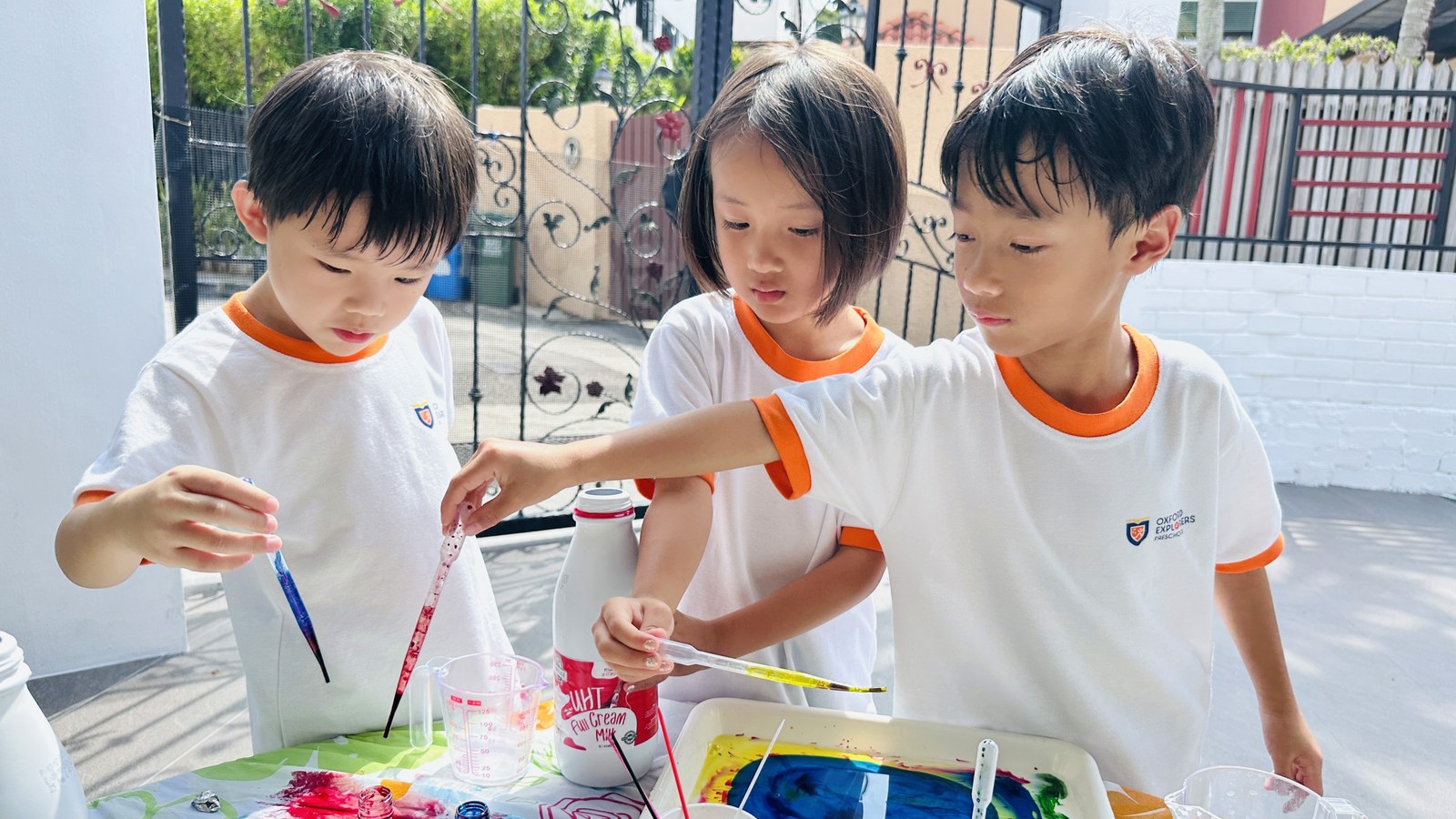
At Oxford Explorers, outdoor time is part of the daily rhythm rather than an occasional reward. Children encounter obstacle courses, nature hunts, gardening, water and sensory play, team games and neighbourhood walks. Each experience has a physical purpose and a learning purpose, while still leaving room for the child to discover something the adult did not plan.
Ollie's takeaway
When you visit a preschool, ask four questions: How often are children outside? What do they actually do there? How do educators extend the learning? How are shade, hydration and weather managed? A little dirt on a uniform is easy to wash out. Confidence, coordination, curiosity and sound judgement are much more valuable things to bring home. Let's Explore Together! 🦦
Sources and further reading
[1] HealthHub Singapore, Getting Fit Through Fun for Kids.
[2] Early Childhood Development Agency, Outdoor Learning.
[3] HealthHub Singapore, Healthy Eyes, Clear Vision.
[4] He et al., Effect of Time Spent Outdoors at School on the Development of Myopia Among Children in China.
[5] Dirani et al., Outdoor activity and myopia in Singapore teenage children.
Book an Explorer Day to see this in action at our Braddell or Bayshore centre.
Previous
A Curriculum That Protects Childhood and Prepares Children for What Comes Next
Next
Play Is Development: What Your Child Is Really Learning
More Related Articles

A Curriculum That Protects Childhood and Prepares Children for What Comes Next
How Oxford Explorers blends the UK EYFS and Singapore's NEL framework into one learning journey, from Playgroup to K2. Joyful play with purposeful progression.
4 minutes
Play Is Development: What Your Child Is Really Learning
Purposeful play builds language, executive function and confidence. What Singapore's NEL framework means by purposeful play, and how to protect play at home.
4 minutes

Copyright © 2026 Oxford Explorers Preschool All Rights Reserved | Terms and Conditions | Privacy Policy
Copyright © 2026 Oxford Explorers Preschool | All Rights Reserved
Terms and Conditions | Privacy Policy
Why Outdoor Play Belongs at the Heart of Preschool
4 minutes
Ollie from Oxford Explorers
Learning
How time outside develops movement, attention, confidence, social judgement and healthier visual habits
To an adult, a puddle may be something to avoid. To a young child, it is a physics experiment, a sensory experience and an excellent opportunity to discover whether two feet make a bigger splash than one.
Outdoor play gives children room to move, materials that change and problems without one correct answer. It is sometimes treated as a break from learning. For young children, it is one of the richest places where learning happens.
Young bodies need space to move
Singapore's physical activity guidance recommends that children aged three to six accumulate at least 180 minutes of varied activity across the day, including at least 60 minutes at moderate-to-vigorous intensity.[1] Preschool is only one part of that day, but regular outdoor sessions make movement easier, more varied and much more joyful.
Running, climbing, balancing, digging, carrying and throwing build strength, coordination and spatial awareness. Handling leaves, sand, water and tools develops fine motor control too. These foundations support everyday independence and later classroom tasks, from opening a lunchbox to controlling a pencil.
The brain is moving too
Singapore's Early Childhood Development Agency describes outdoor learning as learning in, about and through the outdoors.[2] A nature hunt develops observation, classification and vocabulary. Gardening introduces responsibility and change over time. Water play invites prediction and experimentation. An obstacle course develops planning as well as balance: where should I place my foot, what comes next, and what can I change if it does not work?
Outdoor materials are wonderfully uncooperative. A leaf blows away. Sand changes when it is wet. A stick refuses to look exactly like the picture. That unpredictability asks children to notice, adapt and invent. As an otter, I may be slightly biased. But messy, open-ended materials are excellent teachers.
Confidence grows through manageable challenge
Young children need sensible opportunities to test what their bodies can do. Stepping across uneven ground, climbing to an appropriate height or moving quickly around others requires judgement. With close supervision and clear boundaries, children learn to assess distance, capability and consequence.
The aim is not to remove risk entirely. It is to distinguish a worthwhile challenge from a genuine hazard. When adults make every decision, children remain safe in the moment but gain less practice making decisions for themselves.
Outdoor play is social learning
Outside, children negotiate space, wait for equipment, invent rules and adapt when a game changes. These moments exercise communication, self-control and perspective-taking. Disagreements are not proof that play has failed; with skilled adult support, they are opportunities to practise repairing relationships.
The outdoors also creates authentic reasons to communicate. Children need language to coordinate a den, agree a race route, explain a discovery or ask a friend to help carry something heavy. These conversations are spontaneous, purposeful and often sustained. For children who find a busy classroom demanding, the extra space and sensory variety can also make participation feel more accessible.
A small but important eye-health benefit
Outdoor time may also help delay the onset of myopia. Singapore HealthHub recommends at least two hours outdoors each day.[3] A randomised school trial in Guangzhou found that adding 40 outdoor minutes each day reduced new cases over three years,[4] and a Singapore cohort study of older children and teenagers found more outdoor activity was associated with lower odds of myopia.[5] Most of this evidence comes from primary-school age and above rather than preschoolers, so treat outdoor time as preventive support rather than a cure, alongside eye checks and healthy near-work habits.
What outdoor learning looks like at Oxford Explorers
At Oxford Explorers, outdoor time is part of the daily rhythm rather than an occasional reward. Children encounter obstacle courses, nature hunts, gardening, water and sensory play, team games and neighbourhood walks. Each experience has a physical purpose and a learning purpose, while still leaving room for the child to discover something the adult did not plan.
Ollie's takeaway
When you visit a preschool, ask four questions: How often are children outside? What do they actually do there? How do educators extend the learning? How are shade, hydration and weather managed? A little dirt on a uniform is easy to wash out. Confidence, coordination, curiosity and sound judgement are much more valuable things to bring home. Let's Explore Together! 🦦
Sources and further reading
[1] HealthHub Singapore, Getting Fit Through Fun for Kids.
[2] Early Childhood Development Agency, Outdoor Learning.
[3] HealthHub Singapore, Healthy Eyes, Clear Vision.
[4] He et al., Effect of Time Spent Outdoors at School on the Development of Myopia Among Children in China.
[5] Dirani et al., Outdoor activity and myopia in Singapore teenage children.
Book an Explorer Day to see this in action at our Braddell or Bayshore centre.
Previous
A Curriculum That Protects Childhood and Prepares Children for What Comes Next
Next
Play Is Development: What Your Child Is Really Learning
More Related Articles
A Curriculum That Protects Childhood and Prepares Children for What Comes Next
How Oxford Explorers blends the UK EYFS and Singapore's NEL framework into one learning journey, from Playgroup to K2. Joyful play with purposeful progression.
4 minutes
Play Is Development: What Your Child Is Really Learning
Purposeful play builds language, executive function and confidence. What Singapore's NEL framework means by purposeful play, and how to protect play at home.
4 minutes
Copyright © 2026 Oxford Explorers Preschool | All Rights Reserved
Terms and Conditions | Privacy Policy