
How Oxford Explorers blends the UK EYFS and Singapore's NEL framework into one coherent learning journey
Watch a child sort pebbles by size, explain the pattern to a friend and then decide the smallest one is a 'dragon egg'. Is that mathematics, language, imagination or social learning? The honest answer is: all of them.
Young children do not develop in tidy subject boxes. A strong curriculum respects that, while still giving educators a clear view of what each child is learning and what should come next.
For parents in Singapore, the choice is sometimes presented as a joyful, play-rich childhood or serious preparation for Primary 1. At Oxford Explorers, we think that is a false choice. Protect the joy, then use it to build readiness with purpose. That is the clever bit.
The blend: different frameworks, different jobs
EYFS provides the developmental lens. The UK Early Years Foundation Stage considers seven connected areas of learning and places particular emphasis on communication, physical development, and personal, social and emotional development. It guides how educators observe, model, extend and plan through play and guided learning.[1]
NEL provides the Singapore learning map. Singapore's Nurturing Early Learners framework sets local goals across language and literacy, numeracy, discovery of the world, aesthetics and creative expression, and health, safety and motor skills development. It also foregrounds values, social-emotional competencies and learning dispositions.[2]
EYDF supports the earliest years. For children from birth to three, Singapore's Early Years Development Framework keeps cognitive, language, physical and social-emotional development connected and responsive.[3]
Oxford Explorers provides the progression. We translate the frameworks into six connected domains: Communication & Language, Chinese Immersion, Mathematics & Logical Thinking, Understanding the World, Expressive Arts & Design, and Physical Development. The balance becomes progressively more structured from Playgroup to K2 - without turning preschool into an early version of primary school.
What the blend looks like in one real experience

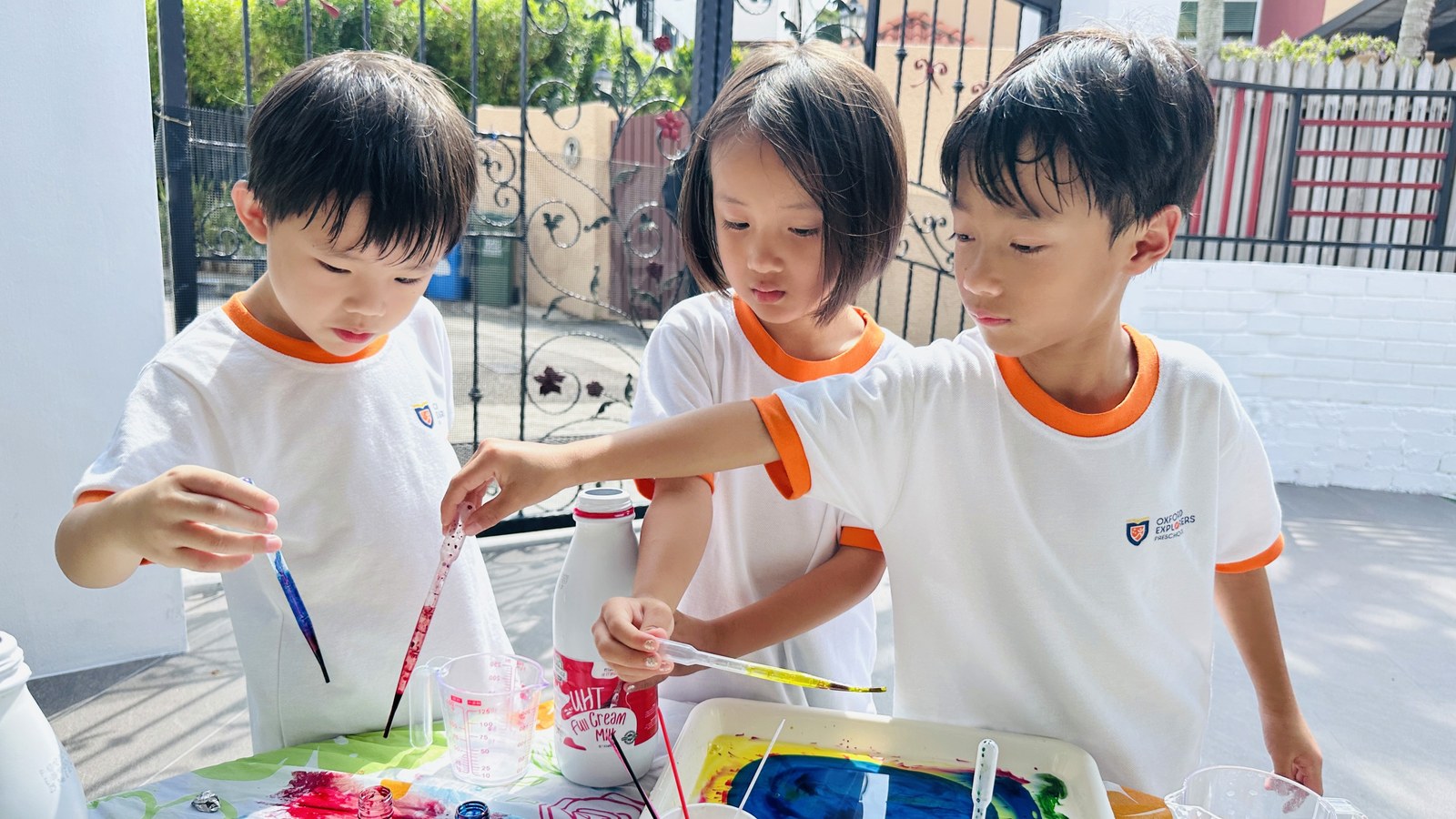
The practical blend begins with a meaningful experience, not a stack of disconnected objectives. Take a neighbourhood investigation. Children might walk nearby, notice signs and buildings, count features, discuss who works there, create a collaborative mural and later present a dream home or neighbourhood.
The EYFS lens helps the educator notice language, confidence, collaboration, movement and imagination. The NEL map makes local goals visible across literacy, numeracy, discovery, creative expression and social awareness. Oxford Explorers then adds age-by-age progression: younger children name, sort and represent what they saw; older children tally, map, write labels, explain design choices and present to a group.
The child experiences one coherent adventure. The educator sees the many capabilities developing inside it. Ideas also become easier to remember because words, numbers, movement and emotion are connected to a real experience. No need to choose between a joyful project and purposeful learning - they are doing the same work.
How the balance changes from Playgroup to K2
In Playgroup and Pre-Nursery, secure relationships, routines, sensory exploration, songs, movement and responsive conversation do most of the heavy lifting. Through Nursery, projects last longer, vocabulary expands and early literacy and numeracy become more visible. In K1 and K2, phonics, comprehension, number relationships, problem-solving, presentation and independence become increasingly explicit.
Oxford Explorers also introduces selected concepts from the local Primary 1 syllabus. These are not delivered as compressed primary-school lessons. Children meet them through concrete materials, stories, experiments, discussion and reasoning. Sorting and counting develop towards tallying, place value, data handling and simple word problems. Stories and poems develop into retelling, oral comprehension, show-and-tell and early writing.
The educator makes the blend real
A framework cannot create quality by itself. A Singapore study of 108 K1 classrooms found that simply providing learning centres did not guarantee purposeful play; the quality of adult instructional support mattered.[4]
That is why Oxford Explorers educators observe closely and intervene deliberately. One child may need a new word. Another may need help entering a group. A third may be ready for a harder number relationship. The experience can be shared while the next step remains individual.
An otter, if you will forgive the comparison, does not learn the river by studying a map of it. Neither does a child learn the world from a worksheet. Both need someone nearby who knows which part is worth exploring next.
Ollie's takeaway
A strong curriculum should be visible in the child, not only in the timetable. By K2, look for confident communication, curiosity with numbers and stories, growing independence, resilience and the ability to learn with others. Global developmental practice, Singapore relevance and clear progression should feel like one journey. Let's Explore Together! 🦦
Sources and further reading
[1] UK Department for Education, Early years foundation stage statutory framework.
[2] Singapore Ministry of Education, Nurturing Early Learners Framework.
[3] Early Childhood Development Agency, Early Years Development Framework 2023.
[4] Bautista et al., Purposeful play during learning centre time: from curriculum to practice.
Book an Explorer Day to see this in action at our Braddell or Bayshore centre.