
Technology Without Screens: What Children Learn When They Build Things
5 minutes
Ollie from Oxford Explorers
Learning

Why tinkering, making and 3D printing teach more about technology than a tablet ever will
A five-year-old draws a boat with three funnels, hands over the paper and asks a perfectly reasonable question: can we make it real? Twenty minutes later a printer is humming and six children are watching a small plastic hull appear one layer at a time, like a very slow magic trick.
That is technology education, and there is not a screen in sight. The useful question is not how many devices a preschool owns, but whether a child is consuming something or making something. A tablet mostly asks a child to watch and tap. A pile of materials asks them to plan, build, fail and try again.

The screen is not the technology
The American Academy of Pediatrics recommends limiting screen media for children aged two to five to about an hour a day of high-quality programming watched with an adult, and is clear that hands-on, social play is what builds language, thinking and social-emotional skills in the early years.[1]
So the goal is not a better app. It is real objects, real problems and real collaboration, with technology treated as one more material a child can shape, like clay or paint.
What tinkering actually teaches
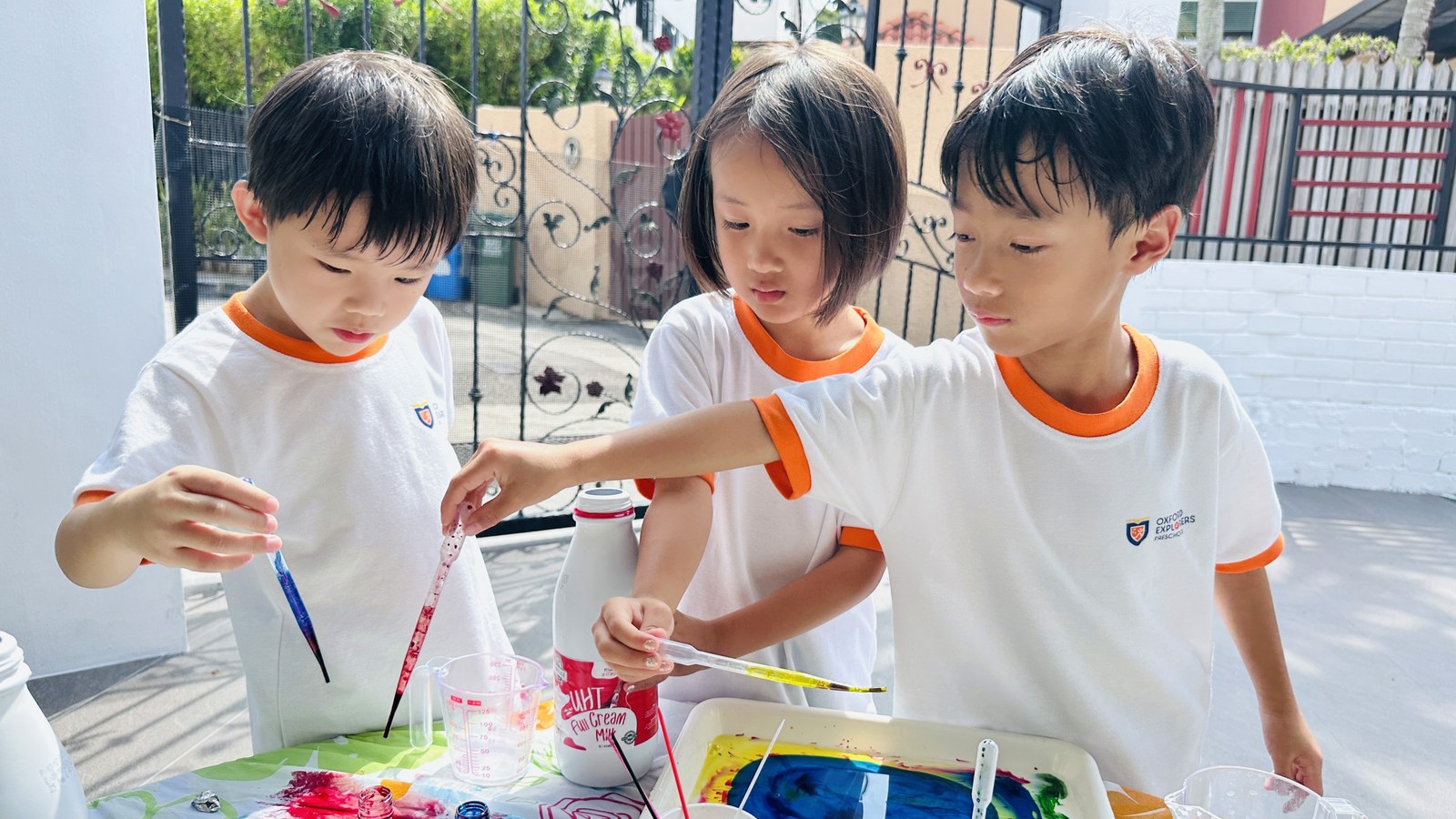
Building something that does not work is unexpectedly valuable. The child has to find the problem, change one thing and test it again. That loop is the heart of engineering thinking, and young children are entirely capable of it.
Research on the TangibleK robotics programme found that kindergarten-aged children could learn computational thinking ideas such as sequencing and debugging through hands-on work with tangible materials rather than screens.[2] In practice: working out which step comes first, finding the one part that is wrong instead of abandoning the whole thing, and explaining an idea clearly enough that a friend can help build it.
Otters are keen tinkerers, I should admit. We carry a favourite stone and use it to open things that would rather stay closed, and it takes a great many attempts. Children do something remarkably similar with a tower of blocks.
Spatial thinking: the quiet advantage
When a child imagines a shape, turns it around in their mind and works out that the base needs to be wider, they are doing spatial thinking. It is easy to overlook because it is invisible. A large meta-analysis found that spatial skills are highly trainable, that the gains last and transfer to tasks the child never practised, and that spatial ability is associated with later success in science, technology, engineering and mathematics.[3]
Designing a real object gives children a reason to do this work. The bridge either holds the toy car or it does not, and that feedback is far more interesting than a worksheet.
Where 3D printing fits in
3D printing makes the journey visible. A child sketches an idea, watches it take shape and then holds the finished object. There is an underrated lesson in the waiting, too: a print takes time, and some things worth having cannot be hurried.
The research is encouraging rather than settled. A scoping review of 3D printing with young learners reports promising outcomes for creativity, spatial reasoning and design thinking, while noting the evidence base is still developing and most studies involve primary-aged children rather than preschoolers.[4] It earns its place, and we would rather say that honestly than overstate it.
What this looks like at Oxford Explorers
Oxford Explorers has 3D printers in school, so a child's own idea can become an object they carry home. It sits alongside daily outdoor play, the art studio and our weekly Funtastic Friday activities, and it is treated as a creative material rather than a special event. The educator's job is the same as everywhere else in our curriculum: notice what this particular child is ready for. One may need the words to describe what went wrong. Another may be ready to predict the fix before testing it.
Trying it at home
You do not need a printer. Build with blocks, boxes and whatever the recycling was going to claim. Cook something together and talk about why the steps happen in that order. Ask your child to draw an invention and explain how it would work, because the explaining is where most of the thinking happens. And when it collapses, resist the urge to rebuild it yourself.
Ollie's takeaway
When you visit a preschool, ask what the children make, not what devices the school owns. Ask what happens when a child's idea does not work first time. Technology is not a screen to sit in front of. It is a way of turning an idea into a thing that exists, and children who learn that early grow up believing they can build the world rather than only watch it. Let's Explore Together! 🦦
Sources and further reading
[1] American Academy of Pediatrics, Media and Young Minds.
[2] Bers et al., Computational thinking and tinkering in an early childhood robotics curriculum.
[3] Uttal et al., The malleability of spatial skills: a meta-analysis of training studies.
[4] Fokides and Lagopati, The utilization of 3D printers by elementary-aged learners: a scoping review.
Book an Explorer Day to see how our children create with technology, no screens required.
More Related Articles

A Curriculum That Protects Childhood and Prepares Children for What Comes Next
How Oxford Explorers blends the UK EYFS and Singapore's NEL framework into one learning journey, from Playgroup to K2. Joyful play with purposeful progression.
4 minutes

Why Outdoor Play Belongs at the Heart of Preschool
Movement, confidence, social judgement and healthier eyes. Why daily outdoor play is central at Oxford Explorers Singapore, plus four questions to ask any preschool.
4 minutes
Play Is Development: What Your Child Is Really Learning
Purposeful play builds language, executive function and confidence. What Singapore's NEL framework means by purposeful play, and how to protect play at home.
4 minutes

They Are Not Too Young For Sport
Running, catching, kicking and balancing build far more than fitness. What play-based sport teaches preschoolers, and why the medals can wait.
4 minutes

Copyright © 2026 Oxford Explorers Preschool All Rights Reserved | Terms and Conditions | Privacy Policy
Copyright © 2026 Oxford Explorers Preschool | All Rights Reserved
Terms and Conditions | Privacy Policy
Technology Without Screens: What Children Learn When They Build Things
5 minutes
Ollie from Oxford Explorers
Learning
Why tinkering, making and 3D printing teach more about technology than a tablet ever will
A five-year-old draws a boat with three funnels, hands over the paper and asks a perfectly reasonable question: can we make it real? Twenty minutes later a printer is humming and six children are watching a small plastic hull appear one layer at a time, like a very slow magic trick.
That is technology education, and there is not a screen in sight. The useful question is not how many devices a preschool owns, but whether a child is consuming something or making something. A tablet mostly asks a child to watch and tap. A pile of materials asks them to plan, build, fail and try again.
The screen is not the technology
The American Academy of Pediatrics recommends limiting screen media for children aged two to five to about an hour a day of high-quality programming watched with an adult, and is clear that hands-on, social play is what builds language, thinking and social-emotional skills in the early years.[1]
So the goal is not a better app. It is real objects, real problems and real collaboration, with technology treated as one more material a child can shape, like clay or paint.
What tinkering actually teaches
Building something that does not work is unexpectedly valuable. The child has to find the problem, change one thing and test it again. That loop is the heart of engineering thinking, and young children are entirely capable of it.
Research on the TangibleK robotics programme found that kindergarten-aged children could learn computational thinking ideas such as sequencing and debugging through hands-on work with tangible materials rather than screens.[2] In practice: working out which step comes first, finding the one part that is wrong instead of abandoning the whole thing, and explaining an idea clearly enough that a friend can help build it.
Otters are keen tinkerers, I should admit. We carry a favourite stone and use it to open things that would rather stay closed, and it takes a great many attempts. Children do something remarkably similar with a tower of blocks.
Spatial thinking: the quiet advantage
When a child imagines a shape, turns it around in their mind and works out that the base needs to be wider, they are doing spatial thinking. It is easy to overlook because it is invisible. A large meta-analysis found that spatial skills are highly trainable, that the gains last and transfer to tasks the child never practised, and that spatial ability is associated with later success in science, technology, engineering and mathematics.[3]
Designing a real object gives children a reason to do this work. The bridge either holds the toy car or it does not, and that feedback is far more interesting than a worksheet.
Where 3D printing fits in
3D printing makes the journey visible. A child sketches an idea, watches it take shape and then holds the finished object. There is an underrated lesson in the waiting, too: a print takes time, and some things worth having cannot be hurried.
The research is encouraging rather than settled. A scoping review of 3D printing with young learners reports promising outcomes for creativity, spatial reasoning and design thinking, while noting the evidence base is still developing and most studies involve primary-aged children rather than preschoolers.[4] It earns its place, and we would rather say that honestly than overstate it.
What this looks like at Oxford Explorers
Oxford Explorers has 3D printers in school, so a child's own idea can become an object they carry home. It sits alongside daily outdoor play, the art studio and our weekly Funtastic Friday activities, and it is treated as a creative material rather than a special event. The educator's job is the same as everywhere else in our curriculum: notice what this particular child is ready for. One may need the words to describe what went wrong. Another may be ready to predict the fix before testing it.
Trying it at home
You do not need a printer. Build with blocks, boxes and whatever the recycling was going to claim. Cook something together and talk about why the steps happen in that order. Ask your child to draw an invention and explain how it would work, because the explaining is where most of the thinking happens. And when it collapses, resist the urge to rebuild it yourself.
Ollie's takeaway
When you visit a preschool, ask what the children make, not what devices the school owns. Ask what happens when a child's idea does not work first time. Technology is not a screen to sit in front of. It is a way of turning an idea into a thing that exists, and children who learn that early grow up believing they can build the world rather than only watch it. Let's Explore Together! 🦦
Sources and further reading
[1] American Academy of Pediatrics, Media and Young Minds.
[2] Bers et al., Computational thinking and tinkering in an early childhood robotics curriculum.
[3] Uttal et al., The malleability of spatial skills: a meta-analysis of training studies.
[4] Fokides and Lagopati, The utilization of 3D printers by elementary-aged learners: a scoping review.
Book an Explorer Day to see how our children create with technology, no screens required.
More Related Articles
A Curriculum That Protects Childhood and Prepares Children for What Comes Next
How Oxford Explorers blends the UK EYFS and Singapore's NEL framework into one learning journey, from Playgroup to K2. Joyful play with purposeful progression.
4 minutes
Why Outdoor Play Belongs at the Heart of Preschool
Movement, confidence, social judgement and healthier eyes. Why daily outdoor play is central at Oxford Explorers Singapore, plus four questions to ask any preschool.
4 minutes
Play Is Development: What Your Child Is Really Learning
Purposeful play builds language, executive function and confidence. What Singapore's NEL framework means by purposeful play, and how to protect play at home.
4 minutes
They Are Not Too Young For Sport
Running, catching, kicking and balancing build far more than fitness. What play-based sport teaches preschoolers, and why the medals can wait.
4 minutes
Copyright © 2026 Oxford Explorers Preschool | All Rights Reserved
Terms and Conditions | Privacy Policy